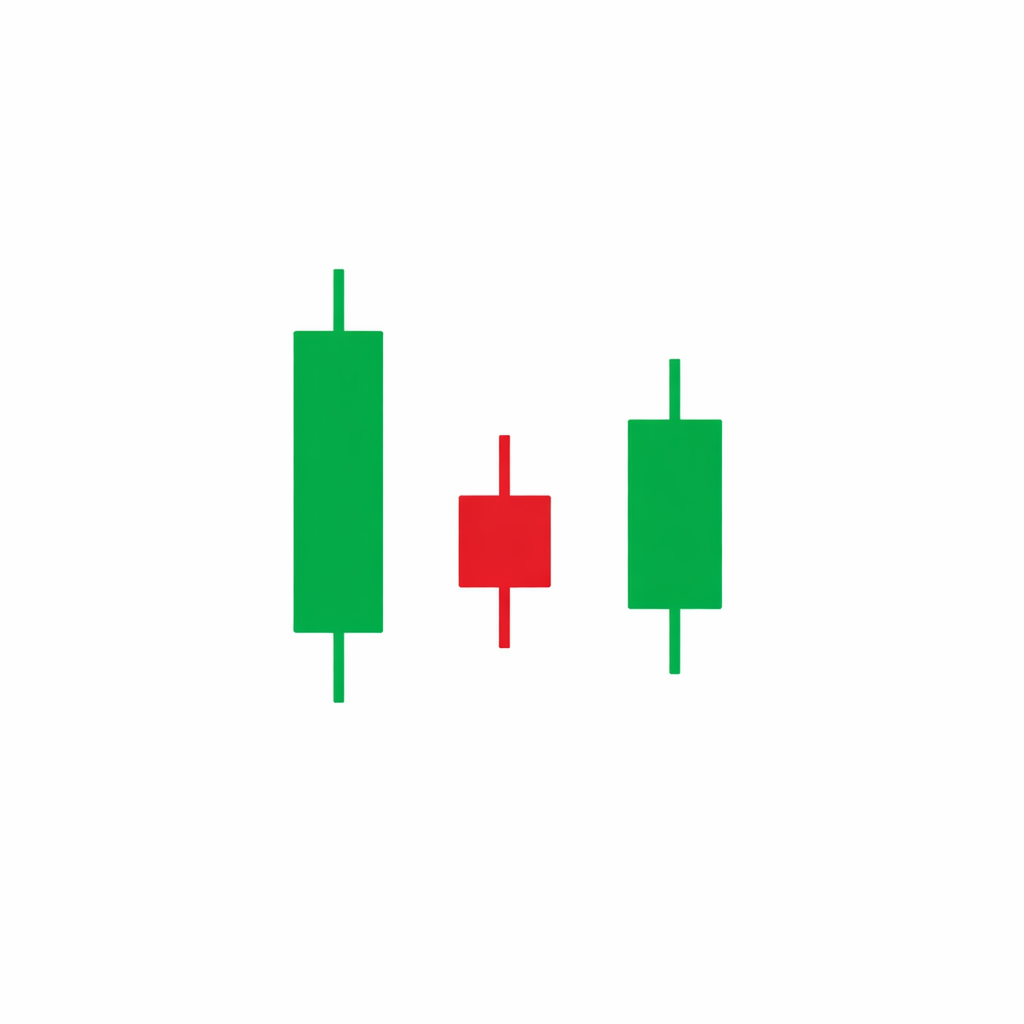
Accumulation/Distribution Indicator: Complete Guide
A/D line uses the relationship between closing price and the high-low range along with volume to determine whether an instrument is being accumulated or distributed.

Settings — A/D
| Category | volume |
| Default Period | null |
| Best Timeframes | H1, H4, D1 |
Most volume indicators simply count how much was traded. The Accumulation/Distribution line goes further — it asks where price closed within each candle's range, then weights that position by volume. The result is a running total that reveals whether smart money is quietly buying into weakness or selling into strength, often before price makes its next major move.
Key Takeaways
- The A/D line is built on a two-step process. First, it calculates the Money Flow Multiplier (MFM) for each candle: MFM =...
- Three core signals drive A/D interpretation: confirmation, bullish divergence, and bearish divergence. Confirmation is ...
- A surprising reality: the H1 chart produces the most A/D signals, but the D1 chart produces the most reliable ones. Here...
1How Does the Accumulation/Distribution Indicator Actually Calculate Its Value?
The A/D line is built on a two-step process. First, it calculates the Money Flow Multiplier (MFM) for each candle: MFM = [(Close − Low) − (High − Close)] ÷ (High − Low). This produces a value between −1 and +1. A close right at the candle's high gives +1. A close at the exact low gives −1. A close dead in the middle gives 0.
Second, that multiplier is scaled by volume: Money Flow Volume = MFM × Period Volume. This result is then added to the previous A/D value to create a running cumulative line.
Think of it like a crowd voting with money. If 500,000 shares trade and price closed near the top of the range, the crowd voted bullish with most of that volume. If price closed near the bottom despite heavy volume, the crowd voted bearish. The A/D line keeps a running tally of all those votes.
Because the line is unbounded — it has no fixed upper or lower limit — the absolute number on the y-axis is meaningless. What matters is the direction and slope of the line relative to price. A steeply rising A/D line signals aggressive accumulation. A flat, choppy A/D line signals indecision regardless of what price is doing.
2What Do Rising, Falling, and Diverging A/D Lines Signal?
Three core signals drive A/D interpretation: confirmation, bullish divergence, and bearish divergence.
Confirmation is the baseline case. When price rises and the A/D line rises in parallel, volume is flowing in on up-closes — the move has genuine buying pressure behind it. When both fall together, distribution is confirmed. These signals don't generate entries on their own, but they validate momentum signals from other tools.
Bullish divergence is the high-probability setup most traders hunt. Price makes a new lower low, but the A/D line makes a higher low. Translation: even though price dropped, volume was being absorbed near the top of each candle's range. Buyers were stepping in quietly. This divergence preceded the February 2016 bottom in crude oil by approximately three weeks — the A/D line stopped making lower lows while price was still grinding down.
Bearish divergence is the mirror image. Price makes a new higher high, but A/D rolls over or flattens. Heavy volume is hitting on down-closes within each bar, even as the headline number ticks up. This is distribution disguised as a rally.
One important distinction: divergences are warning signals, not triggers. Price can continue against the divergence for several candles before reversing. Combine A/D divergence with a candlestick reversal pattern or a break of a short-term trendline before committing to a position.
“A surprising reality: the H1 chart produces the most A/D signals, but the D1 chart produces the most reliable ones.”
3Which Timeframe Gets the Most Reliable A/D Signals?
A surprising reality: the H1 chart produces the most A/D signals, but the D1 chart produces the most reliable ones. Here is why each timeframe has a distinct role.
H1 (1-Hour): The A/D line on H1 is sensitive and reactive. It picks up intraday institutional flow shifts quickly, making it useful for timing entries identified on higher timeframes. The noise-to-signal ratio is higher here, so use H1 A/D only to refine entry timing, not to generate directional bias.
H4 (4-Hour): This is the sweet spot for swing traders. H4 smooths out the intraday noise while still updating frequently enough to catch multi-day accumulation or distribution phases. Divergences on H4 typically resolve within 3–10 candles, giving a manageable trade duration. Most professional swing setups cross-reference H4 A/D with H4 price structure.
D1 (Daily): Daily A/D divergences carry the most weight. When the D1 A/D line diverges from price for 5 or more consecutive sessions, the probability of a meaningful reversal increases substantially. The tradeoff is lag — by the time a D1 divergence is confirmed, early entries are gone. Use D1 for strategic bias and position sizing decisions.
The practical workflow: establish directional bias from D1 A/D, identify the setup structure on H4, and use H1 A/D to time the entry candle.
4How Do You Apply A/D in a Real Trading Setup?
Here is a concrete example of a full A/D-based trade setup on EUR/USD using H4 charts.
Step 1 — Identify a price extreme. Price has been declining for 12 H4 candles and is testing a prior support zone near a round number.
Step 2 — Check A/D divergence. While price made a lower low on candle 12, the A/D line's low on candle 9 was deeper. Candles 10–12 show A/D rising while price continued lower. Classic bullish divergence.
Step 3 — Wait for a trigger. A bullish engulfing candle forms at the support zone on candle 13. This is the entry trigger — the divergence plus price action confirmation.
Step 4 — Define risk. Stop loss goes below the wick of candle 12 (the price low), not below candle 9. The divergence means that low has volume support. A 25-pip stop on EUR/USD H4 is reasonable for this setup type.
Step 5 — Target. The first target is the origin of the decline, which represents the distribution zone. If A/D continues rising as price recovers, hold for the full target.
Pulsar Terminal makes this workflow efficient — once the A/D divergence is identified, you can set multi-level take-profit orders and a trailing stop directly on the chart, so the trade manages itself as momentum builds.
The failure condition: if price triggers your entry but A/D immediately rolls back over and makes a new low, exit. The divergence has failed, and the original downtrend likely has more room.
“The A/D indicator has three structural weaknesses every trader needs to understand before relying on it.”
5What Are the Limitations of the Accumulation/Distribution Line?
The A/D indicator has three structural weaknesses every trader needs to understand before relying on it.
Gap blindness. The formula only uses the high, low, and close of each individual candle. It ignores gaps between candles entirely. If a stock gaps down 4% at the open but closes near the top of that day's range, A/D records bullish accumulation — even though anyone who held overnight just lost 4%. On markets with frequent overnight gaps, this distortion can make the A/D line misleading.
Volume data quality. Forex spot market volume data is broker-tick-volume, not true traded volume. Each broker sees only their own order flow. The A/D line on a forex chart is therefore an approximation based on price activity frequency, not actual dollar flow. It still works — tick volume correlates reasonably well with real volume — but it is not the same precision you get on equities or futures.
No overbought/oversold context. Because the A/D line is unbounded and cumulative, you cannot look at the absolute level and declare a market overbought. A line at 50,000,000 is not inherently more stretched than a line at 5,000,000. This makes A/D less useful in ranging markets where mean-reversion signals are more valuable than trend-following ones. In those conditions, oscillators like the Chaikin Money Flow — which uses a fixed 20-period window instead of a cumulative sum — offer more actionable context.
Despite these limitations, A/D remains one of the most direct ways to assess whether volume is supporting or contradicting price direction — a question that sits at the core of every trading decision.
Frequently Asked Questions
Q1What is the difference between the A/D line and On-Balance Volume (OBV)?
OBV assigns all of a candle's volume to either buyers or sellers based purely on whether the close was up or down from the previous candle. The A/D line is more nuanced — it weights volume by where price closed within the candle's high-low range. This means A/D can show accumulation even on a down-day if price closed near the top of that day's range, which OBV would entirely miss.
Q2Can the A/D indicator be used on all asset classes?
Yes, but with different reliability levels. A/D works best on equities and futures where exchange-reported volume data is precise. On forex spot pairs, it uses tick volume as a proxy for real volume, which introduces some inaccuracy. On crypto markets, volume data varies significantly between exchanges, so cross-referencing multiple data sources improves reliability.
Q3How long should a divergence last before it's considered significant?
On H4 charts, a divergence spanning at least 3 candles is the minimum threshold worth watching; 5 or more candles makes the signal substantially stronger. On D1 charts, look for divergences that persist across at least 4–5 sessions. Single-candle divergences are almost always noise and should be ignored without additional confirmation.
Top Brokers
About the Author
Daniel Harrington
Senior Trading Analyst
Daniel Harrington is part of the Pulsar Terminal team, where he leads the blog and editorial content. With over 12 years of experience in forex and derivatives markets, he covers MT5 platform optimization, algorithmic trading strategies, and practical insights for retail traders.

Risk Disclaimer
Trading financial instruments carries significant risk and may not be suitable for all investors. Past performance does not guarantee future results. This content is for educational purposes only and should not be considered investment advice. Always conduct your own research before trading.
Use This Indicator
Use This Indicator — A/D
Advanced charting and real-time A/D analysis on MetaTrader 5.
Get Pulsar Terminal