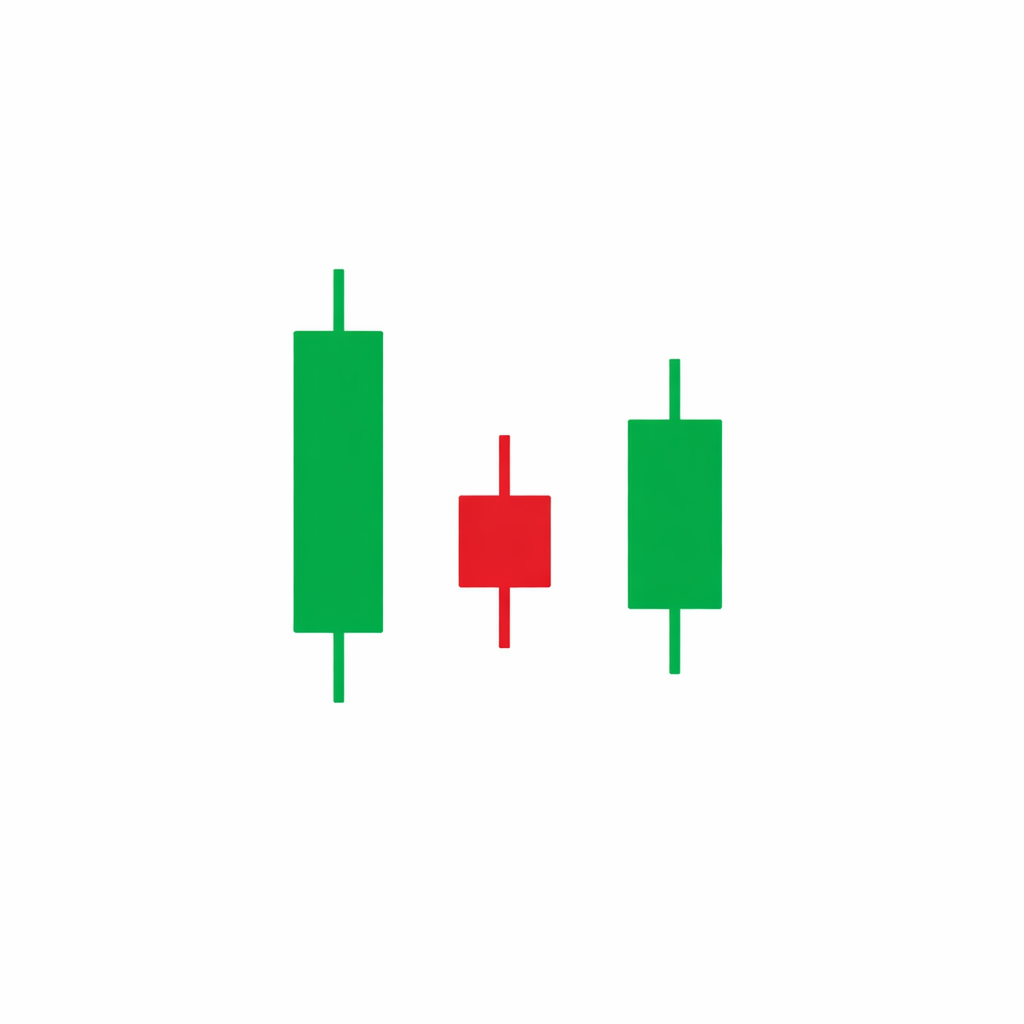
Volume Indicator Guide: Read Market Participation
Volume displays the number of contracts or lots traded per bar, providing the most fundamental measure of market participation and interest.

Settings — Vol
| Category | volume |
| Default Period | null |
| Best Timeframes | M15, H1, H4 |
Most traders obsess over price patterns while ignoring the one metric that tells you whether anyone actually believes in the move — volume. The Volume indicator counts the exact number of contracts or lots traded per bar, making it the rawest, most unfiltered measure of market participation available. When price moves without volume, you're watching a ghost.
Key Takeaways
- There's no complex formula here. Volume simply counts the total number of contracts, lots, or ticks exchanged during eac...
- High volume on a bullish candle is conviction. High volume on a bearish candle is distribution. Low volume on either dir...
- The Volume indicator has no adjustable parameters — no period, no smoothing, no input fields. What you control is the ti...
1How the Volume Indicator Works: The Math, Simplified
There's no complex formula here. Volume simply counts the total number of contracts, lots, or ticks exchanged during each bar's open-to-close window. A bar closes, the counter resets, and the next bar starts from zero. That's the entire calculation.
Compared to derived indicators like RSI or MACD — which apply multiple mathematical transformations to price — Volume is raw data. No smoothing, no lag from averaging, no interpretation baked in. What you see is exactly what happened.
On MetaTrader 5, the Volume indicator displays as a histogram below the main chart. Each bar's height represents total activity for that period. Green bars typically indicate the current bar's volume is higher than the previous bar; red indicates lower. This color coding gives you an immediate visual read on whether participation is growing or shrinking.
One clarification worth making: in forex markets, true volume (number of actual currency units traded globally) is impossible to capture. MT5 uses tick volume — the number of price changes per bar — as a proxy. Research published around 2014 by Caspar Marney and others confirmed tick volume correlates with real volume at roughly 90-95% in major pairs, making it a reliable substitute for EUR/USD, GBP/USD, and USD/JPY.
Unlike on-balance volume (OBV) or Chaikin Money Flow, raw Volume doesn't accumulate over time. Each bar stands alone. That isolation is a feature, not a limitation — it lets you compare discrete periods without compounding distortions.
2Volume Signal Interpretation: Bullish, Bearish, and Divergence Setups
High volume on a bullish candle is conviction. High volume on a bearish candle is distribution. Low volume on either direction is noise. That three-part framework covers 80% of what Volume tells you.
For a buy signal, look for a strong bullish candle — closing near its high, body larger than recent average — accompanied by volume that exceeds the 20-bar average by at least 50%. This pattern suggests institutional participation, not just retail momentum. A breakout above resistance on 2x average volume is far more reliable than the same breakout on below-average volume.
Sell signals mirror this logic. A large bearish candle closing near its low, with volume spiking well above recent norms, signals genuine selling pressure rather than a temporary pullback. Unlike breakouts on thin volume, high-volume drops tend to follow through.
Divergence is where Volume becomes particularly powerful. Price divergence occurs when price makes a new high but volume fails to confirm — the histogram bars are shrinking as price climbs. This is bearish divergence. The opposite pattern, price making new lows while volume contracts, suggests sellers are losing conviction and often precedes reversals.
One specific setup worth watching: the volume climax. A single bar with 3-5x the 20-bar average volume, especially after a prolonged trend, often marks exhaustion rather than continuation. Whereas most traders see a big volume spike and assume the trend is accelerating, the climax pattern actually signals the final flush — the last aggressive participants entering before the move reverses.
Using Pulsar Terminal, you can set SL/TP levels directly on the chart based on these volume signals — for example, placing a stop below the high-volume reversal bar and a take-profit at the next volume-confirmed resistance zone with a single click.
“The Volume indicator has no adjustable parameters — no period, no smoothing, no input fields.”
3Optimal Volume Settings by Timeframe: M15, H1, and H4
The Volume indicator has no adjustable parameters — no period, no smoothing, no input fields. What you control is the timeframe you apply it to, and that choice dramatically changes what the indicator reveals.
On M15, volume reflects intraday microstructure. Spikes here often correspond to news releases, London or New York session opens, or short-term liquidity grabs. Compared to H1, M15 volume is noisier — more false spikes, more single-event distortions. The useful application on M15 is confirming momentum during active sessions (08:00-12:00 GMT for London, 13:30-17:00 GMT for New York overlap). Outside those windows, M15 volume spikes are often meaningless.
H1 is the sweet spot for most retail traders. Volume on the 1-hour chart smooths out the minute-to-minute noise while remaining granular enough to identify intraday trends. A sustained sequence of above-average volume bars on H1 — say, five consecutive green histogram bars during an uptrend — is a strong signal that the move has genuine backing. What I look for on H1 is the first high-volume bar after a consolidation range; that bar frequently defines the direction of the next 5-10 candles.
H4 volume tells a different story. At this timeframe, you're watching multi-session participation. A high-volume H4 bar represents 4 hours of sustained activity, which requires consistent institutional involvement. Unlike M15 spikes that can be triggered by a single news event, H4 volume spikes reflect broader market consensus. These signals are slower to form but carry significantly higher reliability — false breakouts on H4 with high volume occur far less frequently than on lower timeframes.
For swing traders holding positions 2-5 days, H4 volume is the primary filter. For day traders, H1 provides the balance of speed and reliability. M15 works best as a precision entry tool after H1 or H4 has already provided directional bias.
4Practical Volume Application: Building a Complete Trade Setup
Counterintuitively, the most powerful Volume signal is silence — a prolonged period of below-average volume that suddenly breaks. Markets compress into low-volume ranges before explosive moves, and the volume histogram shows this compression clearly as a sequence of short bars.
Here's a concrete setup structure. Identify a key price level — support, resistance, or a round number — on H1. Watch for price to consolidate near that level with volume running below the 20-bar average for at least 6-8 consecutive bars. When a bar finally breaks the level with volume 75% or more above that average, that's your entry trigger. Place your stop below the consolidation range low (for longs) or above the range high (for shorts). Target the next significant structure level.
In my experience, the win rate on this setup improves substantially when you add a second filter: check that the breakout bar's body represents at least 60% of its total range (body-to-wick ratio). High volume on a doji or spinning top doesn't confirm direction — it signals indecision, not conviction.
Volume also serves as a position management tool. If you're in a trending trade and volume starts declining consistently over 3-4 bars, that's an early warning to tighten your trailing stop. The trend isn't necessarily over, but participation is waning. Whereas most traders wait for price to reverse before adjusting stops, monitoring volume lets you act before the price signal appears.
For EUR/USD on H1, average volume typically runs between 800-1,500 ticks per bar during London session. A bar printing 2,500+ ticks is a meaningful spike. On GBP/JPY, average H1 volume runs higher — often 1,200-2,000 ticks — so your spike threshold needs to adjust accordingly. Always calibrate your expectations to the specific instrument, not a universal number.
“Raw Volume outperforms derived volume indicators in one critical area: speed.”
5Volume vs. Other Volume-Based Indicators: What Raw Volume Does Better
Raw Volume outperforms derived volume indicators in one critical area: speed. OBV, VWAP, and Chaikin Money Flow all apply transformations that introduce lag. When a high-volume reversal bar forms, raw Volume shows it instantly. OBV might not reflect the significance for several bars.
Compared to VWAP — which is excellent for intraday mean-reversion strategies — raw Volume doesn't tell you whether buying or selling dominated a bar. VWAP provides price-weighted context that Volume lacks. The two indicators complement each other rather than compete: Volume identifies when something significant happened, VWAP helps determine what it means for price direction.
On-balance volume accumulates volume directionally, which makes it better for identifying long-term accumulation and distribution patterns. Unlike raw Volume, OBV builds a running total that reveals whether smart money is consistently buying dips or selling rallies over weeks. The tradeoff is that OBV can mislead during choppy, sideways markets where the accumulation signal gets distorted.
Money Flow Index (MFI) combines price and volume into a bounded oscillator (0-100), making overbought/oversold readings more explicit than raw Volume provides. However, MFI's smoothing means it misses sharp single-bar events that raw Volume catches immediately — like that volume climax reversal signal described earlier.
The practical answer: use raw Volume as your first filter for any trade. If volume doesn't confirm the setup, no derived indicator will save it. Once volume confirms participation, then consult VWAP or MFI for additional directional context. Raw Volume is the foundation; everything else is refinement.
Frequently Asked Questions
Q1What does a volume spike mean on a price chart?
A volume spike — typically defined as a bar with 2x or more the 20-bar average volume — signals unusually high market participation during that period. It can indicate breakout confirmation, institutional entry or exit, or trend exhaustion (climax volume), depending on where it appears in the price structure.
Top Brokers
About the Author
Daniel Harrington
Senior Trading Analyst
Daniel Harrington is part of the Pulsar Terminal team, where he leads the blog and editorial content. With over 12 years of experience in forex and derivatives markets, he covers MT5 platform optimization, algorithmic trading strategies, and practical insights for retail traders.

Risk Disclaimer
Trading financial instruments carries significant risk and may not be suitable for all investors. Past performance does not guarantee future results. This content is for educational purposes only and should not be considered investment advice. Always conduct your own research before trading.
Use This Indicator
Use This Indicator — Vol
Advanced charting and real-time Vol analysis on MetaTrader 5.
Get Pulsar Terminal